Warum Krafttraining Verletzungen verhindern kann
Die RKC ist bekannt dafür, die Schule der Stärke zu sein. Wir fördern die Bedeutung von Stärke auf eine zielgerichtete Weise. Während Krafttraining viele Anwendungen hat, lass uns besprechen, warum es wichtig ist, ein starker Läufer zu sein. Wenn du anfängst, Krafttraining in dein Programm einzuführen, wirst du physisch stärker und es gibt auch einen physiologischen Aspekt. Krafttraining fördert eine höhere Knochendichte, was die Wahrscheinlichkeit von Haarrissen verringert. Du wirst auch die Bänder, Sehnen und Muskeln stärken – die Gelenke in der richtigen Ausrichtung halten und sichern. Wenn du kein Krafttraining machst, werden bestimmte Bereiche im Körper schwach. Schwach zu sein ist gefährlich, da schwache Muskeln und Knochen zerbrechlich und anfällig für Verletzungen sind.
Krafttraining kann deine muskuläre Arbeitskapazität erhöhen, was deine Lauftechnik verbessern kann. Du wirst weniger wahrscheinlich ermüden, und wenn deine Muskeln stärker sind, kannst du die richtigen Mechaniken über längere Zeiträume aufrechterhalten. Stärkere Muskeln verringern die Wahrscheinlichkeit von Ermüdung während eines Rennens, und Krafttraining hilft, die Typ-2 (schnell zuckenden) Muskelfasern zu erhöhen. Der Fokus auf die fünf großen Muskelgruppen – Knie, Oberschenkelrückseite, Gesäß, Rumpf, Rücken – die beim Laufen verwendet werden, macht das Krafttraining weniger einschüchternd.
Was zu trainieren
Gesäß: Die Gesäßmuskeln sind die Schlüsselmuskelgruppe in der Mechanik des Laufens. Der Gluteus medius wird der Hauptfokus sein, da dieser Muskel die Rotatorenmanschette des Unterkörpers ist. Wenn du dich bewegst, ist es der erste Muskel, der schnell kontrahiert, und er stabilisiert deinen Körper, wenn du auf einem Bein stehst. Laufen ist eine einseitige Aktivität – ein Bein ist in Bewegung – weshalb es entscheidend ist, den Gluteus medius in einseitigen Übungen zu stärken und zu stabilisieren.
Oberschenkelrückseite: Diese starken Jungs stärken deinen unteren Rücken. Wenn sie sich zusammenziehen, beugen sie die Knie, die sich wiederholende Bewegung beim Laufen. Deine Ferse sollte während der Rückschwungbewegung dein Gesäß erreichen, das ermöglicht eine größere Kraftausgabe beim Laufen. Mit stärkeren Oberschenkelrückseiten wirst du in der Lage sein, eine größere Kraftausgabe beim Laufen zu erzeugen. Starke Oberschenkelrückseiten ergänzen dein Gesäß – die beiden zusammen verhindern Rückenschmerzen und ermöglichen es dir, weniger anstrengend auf die hintere Kette zu laufen.
Quadrizeps: Läufer haben normalerweise überentwickelte Quadrizeps, aber es ist trotzdem sinnvoll, sie zu trainieren. Die Quadrizeps sind für zwei Hauptbewegungen beim Laufen verantwortlich, die Beugung des Knies und die Beugung der Hüfte. Diese Aktionen lassen das Bein beim Laufen nach vorne schwingen. Der Ansatz der Quadrizeps befindet sich an der Schambeinfuge, dem knöchernen Vorsprung unterhalb des Knies. Stärkere Quadrizeps helfen, die Knieposition aufrechtzuerhalten. Ein Muskel der Quadrizeps, der vastus medialis, hilft, die Patella und die Kniegelenke beim Laufen zu stabilisieren.
Rumpf: Der Rumpf ist ein schickes Wort für die Bauchmuskeln. Der Rumpf hält deine Haltung aufrecht und sorgt dafür, dass du aufrecht bleibst. Wenn wir laufen, wollen wir eine aufrechte Haltung beibehalten und sicherstellen, dass wir so groß wie möglich sind, was uns einen größeren Bewegungsumfang durch die Hüften ermöglicht. Wir werden diese aufrechte Position beim Laufen mit einem schwachen Rumpf nicht aufrechterhalten können. Das Stärken der Bauchmuskeln ermöglicht eine größere Stabilität. Stärkere Bauchmuskeln reduzieren auch das wackelige Gefühl beim Laufen. Wenn du beim Laufen von Seite zu Seite wackelst, hast du ein Energieleck, das dich verlangsamt.
Rücken: Der Rücken ist der letzte Schlüsselspieler für starkes Laufen. Wie der Rumpf hat der Rücken die gleiche Rolle, deinen Körper aufrecht zu halten. Ein stärkerer Rücken hilft, die Schulterblätter zurückzuziehen, was verhindert, dass die Schultern nach vorne rollen. Eine gute Haltung überträgt sich auf die richtigen Mechaniken beim Laufen. Wenn du Schwierigkeiten hast, deine Haltung aufrechtzuerhalten, musst du deine Rückenmuskulatur verbessern. Ein starker Rücken kann Energielecks im Oberkörper verhindern und sicherstellen, dass du deine Arme beim Laufen optimal trägst. Eine starke Wirbelsäule, ergänzt durch einen starken Mittel- und unteren Rücken, stabilisiert die Wirbelsäule und das Becken.
Wie man trainiert
Wenn wir trainieren, wollen wir Bewegungen und nicht Muskeln trainieren. Die großen Bewegungen sind das Drücken und Ziehen des Unterkörpers, das Drücken und Ziehen des Oberkörpers (vertikal und horizontal), Rumpfarbeit, Tragen und einseitige Bewegungen des Ober- und Unterkörpers. Ich mache Mobilitätstraining ebenfalls zu einem Grundpfeiler in meinem Programm. Es ist eine Mischung aus Bewegung und Kraft – du musst mobil sein, um stark zu sein, und du musst stark sein, um mobil zu sein.
Meiner Meinung nach ist der Push/Pull-Ansatz für Ober- und Unterkörper die optimalste Trainingsmethode. Es spart Zeit und zielt auf jeden Bereich ab. Diese Art des Trainings reduziert auch die Anzahl der Trainingseinheiten pro Woche. Ich empfehle zwei bis vier Tage pro Woche, abhängig von deinem Training.
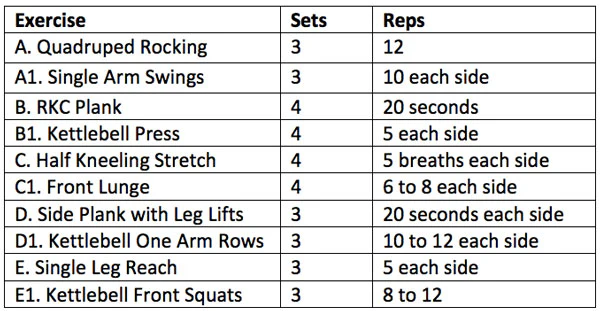
Beispiel für einen Trainingstag: