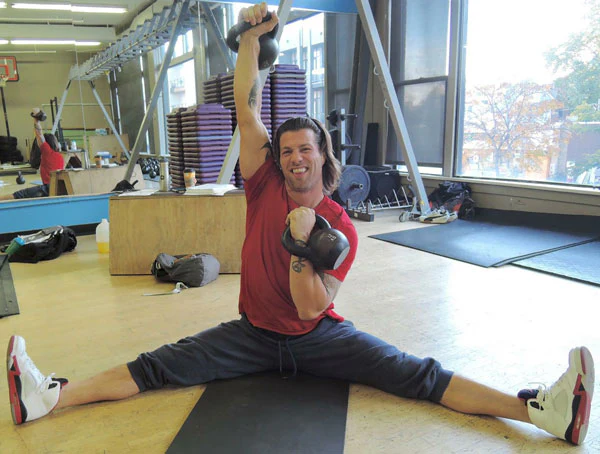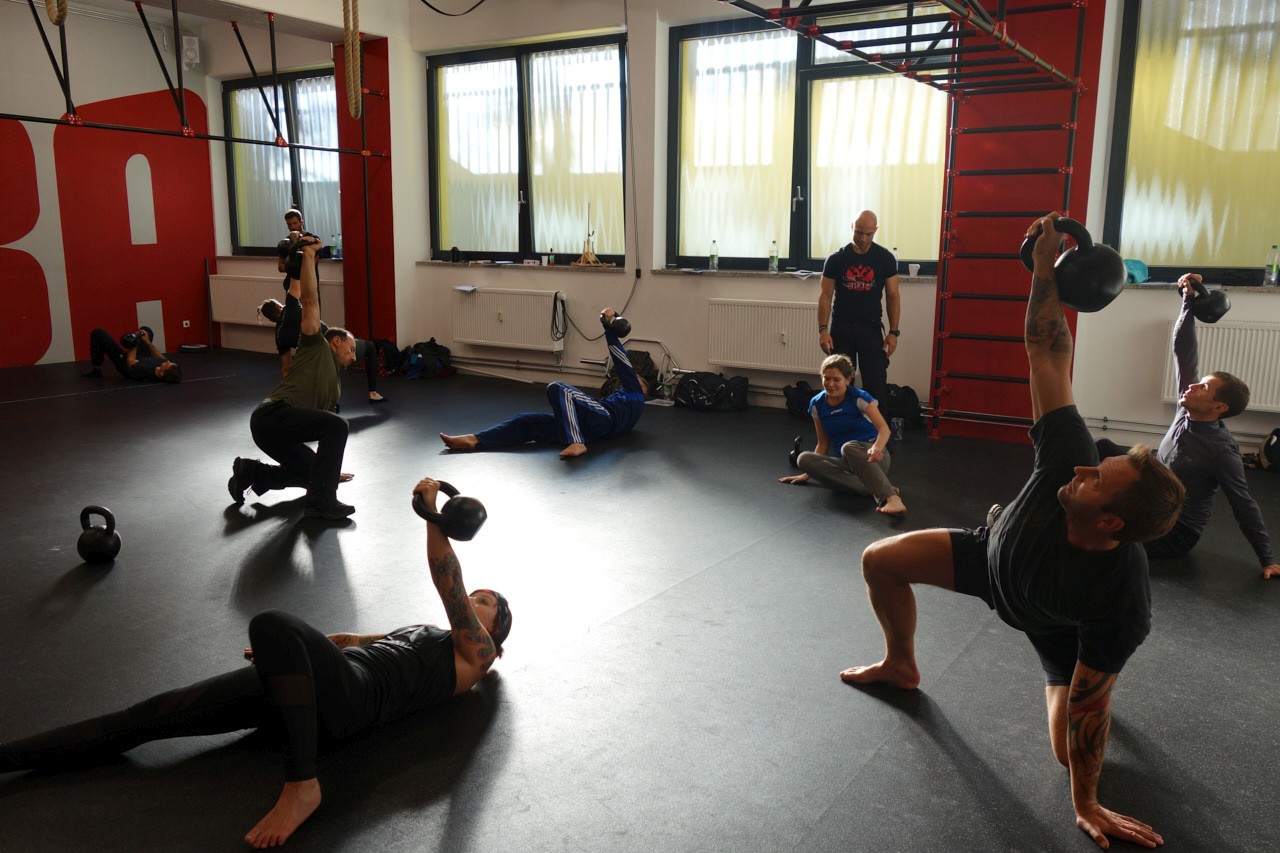
On some level, we all try to make ourselves more presentable. We’ve bought designer jeans from boutique stores and tried designer workouts at twice the price for half the results. If you haven’t reached this conclusion yet, let me help enlighten you: it’s not the clothes on your body that matter, it’s the body in your clothes. So, let’s tune up our bodies and spend our time wisely. Male or female it is important to maintain our muscle mass as we age and the kettlebell gets results. That’s why we train with kettlebells for massive shoulders, thick arms, solid legs, ripped abs and athletic skills for any task.
It’s grind time! Kettlebell ballistics are fun and one of the best ways to increase your conditioning and stamina but if you’re looking to bulk up, then kettlebell grinds are the answer.
Two key variables in the strength and hypertrophy equation are “X” (the speed of the work) and “Y” (time under tension). We want to simplify this equation and solve for X and Y. Every rep of our hypertrophy training program, becomes about decreasing X and increasing Y as we increase the resistance across the sessions. This is why kettlebell ballistics take a back burner during this period of training. To grow our muscles, we also need to choose the right movements. We don’t want to isolate the targeted muscles, because that approach doesn’t yield as much mass. Compound exercises are universally accepted as the most effective way to build muscle and strength. This still holds true at universities and “bro-science labs” around the world. Luckily for us 99% of kettlebell exercises are compound exercises.
Compound movements involve more than one muscle group, and usually use two or more joint systems. With all this tension, we won’t need much variety in our program. Since each exercise supports the next, there isn’t much need for accessory drills. With double servings from a simple menu of exercises, we will stimulate the growth environment.
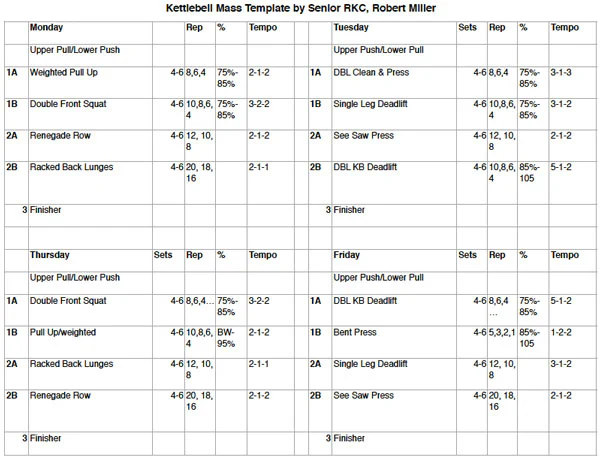
These eight kettlebell drills are essential for building mass:
Kettlebell Front Squat:
Double Kettlebell Deadlift:
Military Press:
Renegade Row:
See-Saw Press:
Weighted Pull-up:
Back Lunges (Kettlebells Racked):
Single-Leg Deadlift:
Bent Press:
To keep growing muscle while combating training plateaus, we must attempt to master the training tactics of irradiation and lifting tempo. The concept of irradiation is important for creating tension and linking tensing muscles together. Strongly tensing a muscle will recruit nearby muscles to assist and support. However, this does not happen automatically. One must force neuromuscular activity to call as much of the muscle fibers into the workload through a full range of motion.
By making light training weights feel heavier during your reps, you force more supporting muscle tissue into activation. This is one of the central themes of the RKC. This type of training takes more focus, more attention to detail, and it isn’t easy—but training isn’t easy, nor should it be. We demand results, and that’s why we crush the handles tightly for the entire set. That’s why we force our inhales and exhales on time. That’s why we flex our glutes, quads and abs as we stand through the top of our squats. When we make our training more difficult by adding tension, we will force more hypertrophic adaptation with 85% resistance for sets of eight to twelve reps.
The tempo of the lift and instructions for maintaining tension throughout the set are the missing pieces from most mass building plans. We must focus during all three phases—eccentric, isometric, and concentric—of the working muscle’s stretch-shortening cycle to maximize growth.
The tempo of the lift is the amount of time spent in each phase under the added tension of the load. Add tension and stay active as the resistance is loaded through the eccentric or “negative” phase. Don’t rush this part, stretching the muscle combined with overload is the most effective stimulus for muscle growth. Pause and hold at the fully loaded position for at least one full second, sometimes up to five. Exploiting this isometric position under great resistance yields significant results.