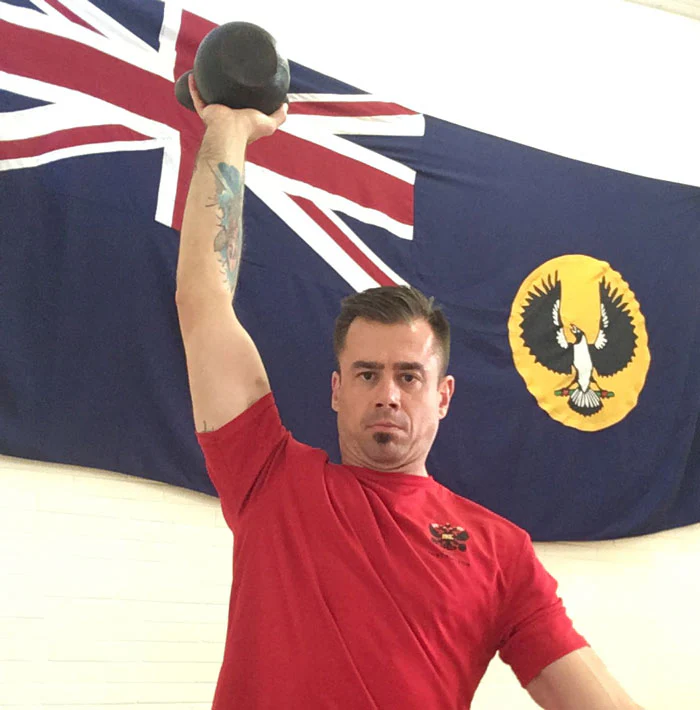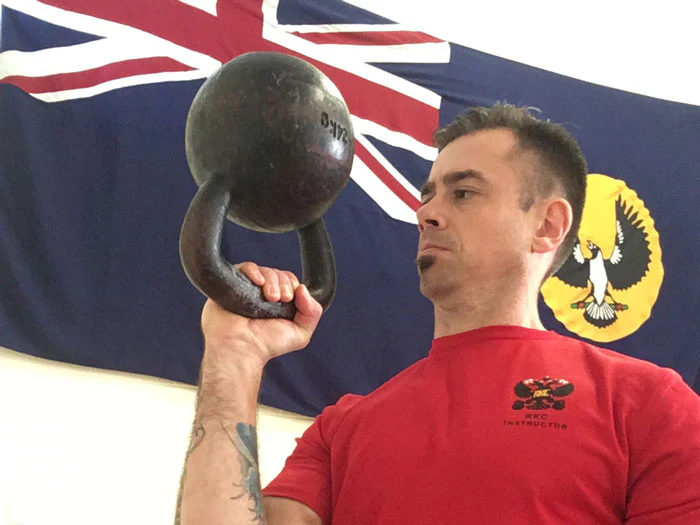
A heavy kettlebell press—or any overhead press for that matter—will always be a super impressive feat of whole-body strength. For some, getting heavy things overhead is the meaning of life, and I can understand why! There are few better feelings than locking out a heavy overhead grind.
You have probably heard the phrase, “To press well, you have to press a lot.” Technically, this statement is true. But, when you regularly work heavy grinds like the press, or any high tension, high threshold lift for high reps like ladders, it can be pretty unforgiving on the body—especially the shoulders. Like many in our RKC community, I am a big fan of push-presses and jerks, especially since they seem to be a little more forgiving on the shoulders.
Enter one of the programming principles taught in the RKC: specialized variety. This important concept allows us to avoid plateaus, improve a skill (like pressing), and can also help us avoid injury.
The biological law of accommodation holds that the more you repeat a given movement, the less effective it will be for achieving your goals. A biological object’s response to a given constant stimulus decreases over time. Accommodation is your body’s decreasing response to a constantly continued stimulus—so, we will need to vary our training a little.
Another training principle—which seems to be the opposite—is the SAID principle. The specific adaptations to imposed demands (SAID) principle states that the more something specific is practiced, the more that specific skill will improve. In other words perfect practice makes perfect when it comes to developing skills.
With specialized variety, we want to choose exercises that are very similar, but are slight variations so we can keep training a movement without reaching a plateau.
Principle One: Change Your Foundation
Changing your lower body position is a simple way to add specialized variety to your pressing. With the regular press we usually stand in a bilateral stance with our feet square and roughly shoulder width apart. But, when we change position?
In real life and especially in sports, we’re very rarely in a perfect bilateral stance. More often, we’re in lunge like or single leg stances. Some of these variations can also have crossover for better sports performance.
- Feet Together
By narrowing your base, your body really has to zip everything up. Pressing with your feet together ensures that you think about drawing everything into your center, while stopping any tension “leaks” of throughout the body.
- Inline Lunge
Similar to pressing with the feet together, but place one leg behind the other (kettlebell on same side as the rear leg). This stance introduces a lateral balance demand and forces the body to zip everything up. You can self-limit the balance demand of this technique—make it harder or easier—by changing the distance or width between the two feet.
- Contralateral and Ipsilateral Stances
Even though these stances are very rarely seen or used, I love using them to strengthen the body contra-laterally (think of an X across the body from shoulder to hip) or ipsilaterally (shoulder to hip on the same side). If you are interested in fascia and slings (see Thomas Myers) then this will be right up your alley. These press variations are done on one leg and can be really challenging. For the contralateral version, the kettlebell in the opposite hand of the foot you are standing on, and for the ipsilateral version, press and stand on the same side.
- Tall Kneeling and Half Kneeling
Without going down the rabbit hole of corrective exercise, both the tall and half kneeling positions give us great pressing options. By taking the knees and ankles out of the movement, we can focus on letting the hips and the core do their work. The goal of the tall and half kneeling positions is to help us create more stability and control while pressing. They can prompt us to tie the upper and lower body together as in the two previous options. The half kneeling option is also self-limiting. Narrowing your base of support (as in the inline lunge press) in the kneeling lunge position creates more instability—and an environment where you will need to stabilize more to keep your balance—just like the standing inline lunge. If you decide to work from a half or tall kneeling position, you really need to make sure your set up in these positions is spot on—a poor setup will not allow you to gain the benefits of these movements.
- V-Seated Press
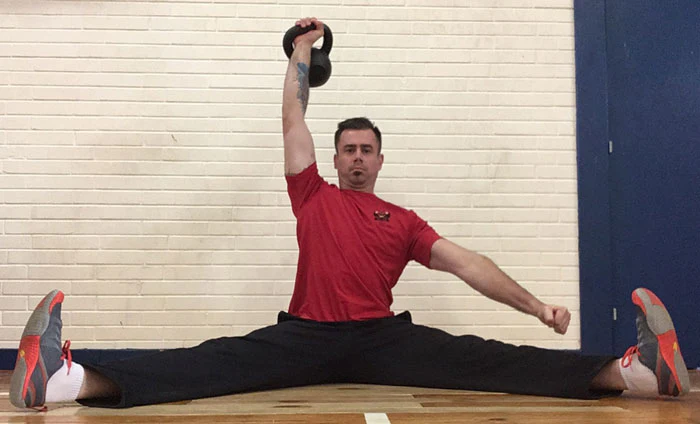
One of my all time favorite all pressing positions is sitting down in semi side split/pancake position with my legs in a V. This is an amazing variation that really helps to tie in the core with the shoulders, lats, and triceps. Watch your lumbo-pelvic positioning in the V-seated position, so your back and lower back stay in a neutral position.