Die wahre Geschichte hinter der Geburt der modernen Kettlebell-Bewegung
- STRENGTH TRAINING
- FITNESS BUSINESS
- JOHN DU CANE
- KETTLEBELL CERTIFICATION
- DRAGON DOOR PUBLICATIONS
- 16KG KETTLEBELL
- DRAGON DOOR ORIGINS
- JOHN DU CANE INTERVIEW
- KETTLEBELL TRAINING HISTO
- MODERN KETTLEBELL MOVEMEN
- THE FIRST KETTLEBELL CERT
- PAVEL TSATSOULINE
- KETTLEBELL HISTORY
- FITNESS CULTURE
- EXERCISE EQUIPMENT
- FITNESS PUBLICATIONS
The Real Story Behind the Birth of the Modern Kettlebell Movement
Adapted from an interview with John Du Cane, founder and CEO of Dragon Door Publications, by Colleen Conlon
Colleen Conlon:
How did the modern kettlebell movement get started?
John Du Cane:
It all started in 1998. We’d already published several books by Pavel, most notably Beyond Stretching and Power to the People! — his acclaimed classic on strength training. Then in ’98, he contributed a great article to Milo Magazine, that iconic, specialized resource for people who like to lift very heavy things.
The article was entitled Vodka, Pickle Juice and Kettlebells — and Other Russian Pastimes. And it had an immediate impact. This was really the first time that kettlebells entered the modern consciousness. IronMind sold an adjustable kettlebell that no one was really paying any attention to. There were no books on kettlebells, there were no videos, there were no courses. It was kind of a forgotten art in this country, and really, in the West, in particular. When it comes to being incisive and inspirational as a writer, Pavel has the gift, no question. No surprise that “Vodka” had the impact it did!
After graduating from school in Russia, Pavel got a gig as a strength and conditioning trainer in Spetsnaz, the Soviet Special Forces. And while he was training the Spetsnaz he also got qualified in Girevoy sport — kettlebell lifting in the Russian style. When he immigrated to the US — I think it was around ’92, ’93 — he was still a very young man. He didn’t bring kettlebells with him. But when he had been in the States for a while, a friend of his, who was a Russian hockey player, brought him a couple of big kettlebells. They were like a 24, and a 32 kilo.
These rusty old kettlebells were hollow, where you add weights inside to change the overall weight. After the article was successful, he approached me, it was like ’98 still, and said, “John, do you think we can do anything with these in the States?” After checking them out, I told him “Yes, I think this might fly in America. So this is what we’ll do. Write a book about it, giving people the vision. Let’s do a video. Let’s make the kettlebells in Minnesota, and let’s come up with our own design.”
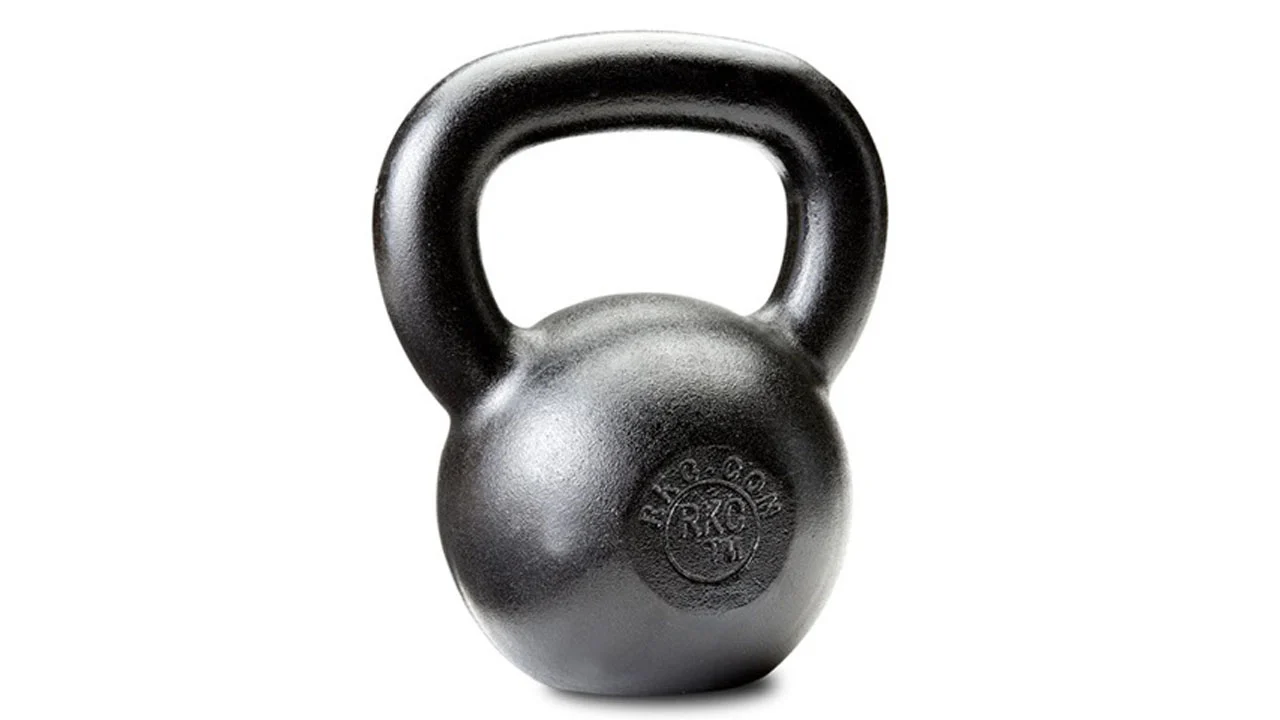
In fact, we were the first people in the world to come up with that 16 kilo kettlebell size. We originated that design. We decided to make them solid, in the three most favored weights in Russia, the 16, 24 and 32. We selected a foundry in St. Paul, designed them, got them manufactured, and then we were set.
Dragon Door designed the world’s first solid 16kg kettlebell, in 2001 — soon to be copied by numerous also-rans.
From my prior experience as director of the Chemical Dependency Certification Board for Minnesota, I had learned the significance of a certification program. Almost all CD counselors were recovering drug addicts and alcoholics. And their problem, when they were holding themselves out as someone to come to for counseling on drug addiction, was their credibility. So yes, they knew a lot about how to inject heroin into their veins and how to drink a gallon of whiskey a day. But were they credible as professional therapists? So the certification board was set up to kind of say, “Hey, we’re it, we’re credible. If you see someone certified with us, then these people are certified as competent counselors.”
So I explained to Pavel that what we really needed to do to launch kettlebells successfully was not just have a product and have good information — we also needed to set ourselves up as the authority for kettlebell training. There was no one in the world who had done that. There was no certification program in existence at that point. So you set yourself up with a certification system, you set the standards, you decide what competency is, you’re IT!
Now, when someone gets certified, that individual is likely to feel a natural allegiance and loyalty to the certification board that they’re connected with. So with full integrity, they can hold themselves out with pride and say, “This is the best system for kettlebell training, this will give you the best results. And yes, I’m certified in this world’s best system.”
So, what you get is a group of highly informed, impassioned enthusiasts who spread the word, in this case about Dragon Doors’ RKC kettlebells and our RKC kettlebell system. So that was kind of the process. That was the kind of decision making and mindset behind the creation of the whole RKC program.
It took a while, obviously, to get it all in place. We launched the first kettlebell training book and video in 2001. It’s called The Russian Kettlebell Challenge.
The first kettlebell book: The Russian Kettlebell Challenge
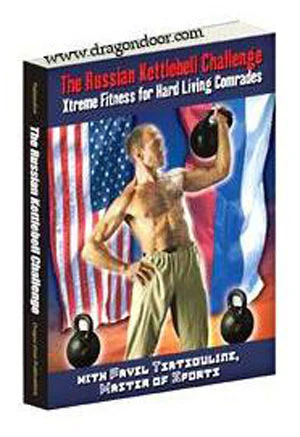
The Russian Kettlebell Challenge, the book that initiated the modern kettlebell movement.
And it was very iconic, wonderfully written, very inspiring. And it gave people for the first time a vision of what they could really do with kettlebells. This is the seminal text that launched the entire modern kettlebell movement. When a new fitness tool is presented to you, you really won’t have much of a clue how to use it, unless there’s someone who gives you a really good vision and a really good understanding of its value and methodology. It’s like, why bother?
And one of the great things about Pavel is he really understood how to take abstruse information, and make it very clear, obvious, entertaining and inspirational. Plus, he was a good looking dude, good physique. Which does not hurt. It’s like, I want to be like Pavel, even if I’m not necessarily a guy. It’s like, I want to be THAT. And so he was a good role model. He walked the talk. Do what I tell you and you can be like me, as it were…
Another major strategy, at the time we launched our first RKC workshop in September 2001, was to institute a highly engaged forum on Dragon Door. Forums have kinda died a death at this point, with the advent of Facebook and other social media, but they could be a huge for a company back in the day. We were ahead of the game, I think, with our forum. It immediately became a thing — a very big thing.
The other thing about the forum is that we got a lot of fantastic information about who our customers were, what motivated them, what excited them. And our customers also started getting really valuable training information. And Pavel is a formidable listener. He really listens to other people and absorbs their wisdom and then makes it his own. Which is a big skill. He did this over and over with the forum and with the customers we were attracting. A personal example: Pavel came and studied Iron Shirt Qigong with me at one point. He used some of those ideas in his own development of isometric training, his strength training, his use of tension. So he’s very good at absorbing and then putting that information out in a way that’s very accessible to people.
We did the very first kettlebell certification in St. Paul around the time of 9/11, and we had, I think, about 16 people. At least five of the people who came to that first cert, ended up starting or being the head guy for a rival kettlebell certification down the road! One of them ended up being the main CrossFit kettlebell guy. Another guy started his own entire international kettlebell business and another guy started a knock-off almost right away, which was unfortunate for us. We didn’t protect our intellectual property very well in those early days, frankly. But, that’s show biz…
The folk who showed up at that first RKC certification, the early adopters, were very savvy, ahead of the game, seeing something that definitely had an edge. They wanted it, and they were excited to become leaders. And they were leaders. We had a lot of strong leadership right from the get go. So boom, it happened in 2001. And then very rapidly it just grew and grew each year. We’re seeing a similar phenomenon now, with our new isometrics training device, the Isochain. Very high-level fitness folk seeing the value way ahead of the crowd and jumping in. We are seeing a whole new cadre of future leaders in isometrics developing before our eyes. It’s a wonderful thing…
Colleen Conlon:
And what was that first RKC certification like?
John Du Cane:
It was a walk in the park compared with the later ones! It’s described as epic. And yes it was, because it was right at the beginning. But for example, I remember we had this African American ex-Dallas Cowboys running back whose career had got sidelined by an injury. He was hoping that our kettlebell program would help get him picked up again as an NFL star. He was built out of rock, I mean, he was as so solid as you can get… I almost broke my hand patting him on the back… So the gentleman is lifting, playing around with a 16 kilo kettlebell. And Pavel comes over to him and very politely — very politely and diplomatically — suggests that maybe he should try using the 24 kilo. And the man of rock and steel goes: “Oh, Okay.”
Down the road, you would have been kind of thrown out of the room if you were a beast and even tried to pick up just a 16. Like, “What do you think you’re doing?” Yeah. But back then we were feeling our way. We had two hour lunch breaks. We would all troop off in cars and hang out at a local restaurant, coming back in a leisurely way. There was no testing.
Colleen Conlon:
I was going to ask, I mean, were you snatch testing?
John Du Cane:
No, no, nothing. And I got a break because I took the first two certifications as a participant myself. So fortunately, I could pass without being tested! Now, the first group were all very strong anyway. But then we had our second group come in, and there were some people who were out of shape. They were fattish and weakish. And we didn’t want to be certifying people as RKCs who couldn’t walk the talk… Our model for a good certified kettlebell coach was someone who was very skilled, very competent, and strong. They needed to be the part, look the part. They needed to be the whole package. We didn’t want to have people representing us who were sub-par physically. There’s certifications you can get in fitness, where you can really be a mess physically and still be considered an okay coach. Not in our world!
Colleen Conlon:
One of my favorite things about going through RKC is the fact that you are tested. You can’t just buy your certification.
John Du Cane:
Exactly, yeah. It’s like those martial arts programs where you can get a mail-in black belt. I mean, it’s just ridiculous, really. So we’ve always held to that. So after the first two certs, we said “We’ve got to start putting some testing in.” So that’s when we came up with the different standards where the snatch test was introduced. And the snatch test is interesting. It’s always been debated.
Colleen Conlon:
Yeah, I’m so curious, John.
John Du Cane:
So, I personally have mixed feelings about the 100 reps. I mean, 100 is arbitrary. There was nothing particularly scientific, I think, about it. It’s like 24 kg is a good size, and 100 sounds like a good number. But the snatch test became a kind of rite of passage, almost cult-like in its fervor. I mean, people enjoy having this extreme goal, and it was an extreme goal. And the near the beginning of the modern kettlebell era —when it was hard to find a good coach to train with before the cert — we’d sometimes have people showing up who didn’t know how to snatch but had to start the day with 100 of them.
And then the RKC started to grow. So you could go and study with a certified trainer and have a clue when you showed up. But there was definitely some sacrifices made, I think. And of course, a lot of people failed initially. Down the road, less people failed. But it weeded out a lot of people who we didn’t feel were going to be good representatives for us. And what it meant was that people who were serious about being RKC trainers needed to train usually for about six months upfront to be able to handle it. It was very extreme. A lot of the early adopters were very macho types, they were people who were really pounding it.
So the training got to be very, very hard, a lot of swings, a lot of weight. And it was often very brutal. And that became the kind of ethos of the movement. Pavel is a very good marketer in his own way. And he had this whole shtick about the evil Russian Empire, and now you’re in Soviet territory. And it’s not who he is really, he’s a gentleman, and he’s a sweet guy.
So Pavel’s Soviet military tough guy schtick became the ethos that was adopted by all the instructors. And it was all good for the first few years… It was fun for quite a while. But I feel it got a bit out of hand, finally, it got a little too regimented for my personal taste. But what it did produce was very, very strong people who had an interest in making sure that the skill was there, that people were genuinely skilled in the use of the kettlebell.
The testing wasn’t limited, of course, to just the snatch test, by any means. What also made the RKC unique, was that we developed a testing system for all the core lifts. So the instructors would go around, and you would get tested on just exactly how well you were doing with each lift.
And then the other thing we did — and I don’t believe any other kettlebell certification has done this before or since — was to evaluate the candidates on how well they trained guests who came in and received a half hour lesson… And people sometimes failed for not having done a good job training the folk who showed up.
Colleen Conlon:
Oh, wow.
John Du Cane:
Oh, yeah. You could be failed just on that. It could be like you weren’t properly respectful to the client. You just didn’t give them good advice. So there was a strength test, skill tests and then there was also testing of your coaching right there.
Colleen Conlon:
That’s so interesting that you bring that up, because I think something that’s been very incredible about my experience going through RKC is the fact that we’re not just coming in to be able to do the skills ourselves. A lot of the people who came in from my class are also within the fitness industry. And you need to learn how to teach other people how to do these skills, especially if you’re not super familiar with getting into a hip hinge as it is. There’s a real skill to that, to being able to check.
John Du Cane:
Oh, there really is. And what I think is wonderful that was developed during the time Pavel was with us — and is being continued even more under Andrea Du Cane’s guidance — is all of the progressions, all of the subtle cues that you can give a client to help them progress and also to handle people who are out a condition or have injuries. In the course of the certification, we are explaining how to work with a variety of types of clients, and how to build them up to where they can genuinely handle whatever it is, whatever drill you’re wanting them to accomplish. So, that’s hugely important for the system.
If you’re wondering, what is the point of RKC, it’s to turn out really skilled coaches. Put aside our marketing as a certification board wanting to present ourselves as the authority. The other thing is, we want people to have the best possible experience. We used to say in the early days in particular, would you be comfortable having this person train your grandmother?
Colleen Conlon:
Oh, I love that.
John Du Cane:
Yeah. And we wanted people to leave, who could train a person’s grandmother, and go out and train an NFL football player, sure, or an LEO or Special Forces. Great, very nice. But how can you handle the grandmother, the young ballerina, whomever? And do a really good job and meet their needs. Or someone who waddles in, who’s way out of weight, or way out of shape, has got knee problems and a messed up shoulder? What are you going to do? How are you going to handle that? And that’s what we’re all about.
Colleen Conlon:
Well, I love the way that you phrase that, because I think so much of the time people just think I’m going to give the hardest, most intense workout, and it’s going to be to that person who can handle a lot. And that’s typically not the case. Most people come along with injuries and from all different walks of life. So I can say this, as somebody who’s gone through the course, I feel very confident about being able to train anybody who comes my way, from all of the skills that I have learned from RKC. And those little details really can make or break a session. So thank you so much for everything that you guys have all put into this learning material, because I don’t know how people who haven’t gone through a course like this are able to actually get people to swing and snatch and clean and squat, injury free.
John Du Cane:
So yeah, there are a lot of hurt people out there who shouldn’t be hurt. And yeah, it’s like the CrossFit syndrome. Gray Cook is great about that, he calls it the crack addict approach to fitness. “Yeah, I know, my leg’s falling off, but I got to put my reps in.”
Colleen Conlon:
What do you think about that? How do you speak to somebody who’s like, “I just need all those reps?”
John Du Cane:
I say that you need to go back to why you’re really doing this in the first place. Particularly the type of folk who are into say, running — in particular they want that high, they want that sense of great accomplishment. You have to remind them that if they persist in trying to work through injuries without paying attention to the imbalances and the asymmetries and everything else that’s going on, they’ll find they’re not going to be able to get those results that they’re looking for. So you need to dial it back — for your own sake — to be able to continue.
I have a background that has influenced our development of the RKC. I’ve been doing Tai Chi and Qi Gong for 40 years, with a Taoist perspective of treating the whole human being. Cultivating everything about yourself spiritually, emotionally, mentally, physically. The physical and mental are completely linked and you need to be paying attention to the whole package in terms of longevity as well. You’re not in it for a quick hit. You want to have a long term high engagement with life and remain vital over the long term.
John Du Cane Martial Arts in the snow with Kwan Dao
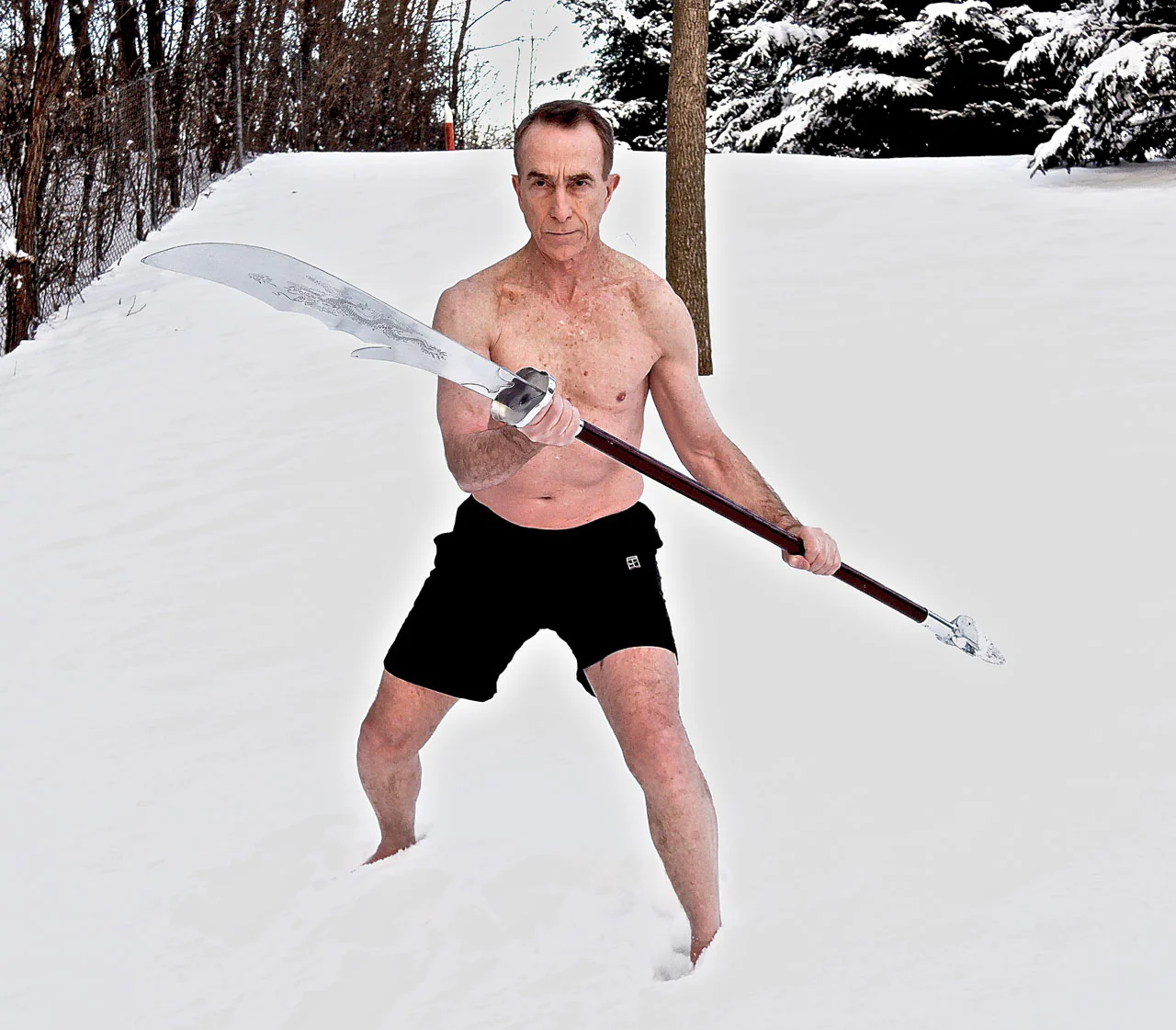
John Du Cane has over forty years of training in Tai Chi and other Chinese martial arts.
So everyone is different on how you handle that but you’ve got to just take them back to why they’re really doing this in the first place. For instance, I recently took up Latin dance. I’m doing Brazilian Zouk, Salsa and Bachata. I was brought up in Africa and over the years have usually danced to African and Reggae. I like music that you dance from the inside out and that’s very rhythmic and tribal and hypnotic. So Bachata in particular is great because it’s very much based in the legs and kind of grounded and has a lot of cool moves. Kettlebell training fits very well with dance, because you have obviously a very good level of conditioning and kettlebells help you move beautifully. And I definitely feel that my Latin dancing of all things has also been improved by kettlebells, which is kind of cool.
John Du Cane with kettlebells in the snow
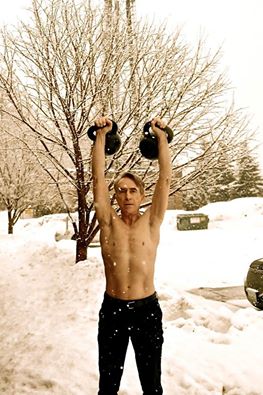
Kettlebells perfectly complement John Du Cane’s other movement activities, be they dance, martial arts, qigong or bodyweight exercise.
Colleen Conlon:
That’s really cool. I love that you bring that up because before I found kettlebells I was really not athletic by any means. And then after going through my level one certification, I remember trying a pull up for the first time after never being able to get one and then out of nowhere, having not trained it, I was able to get a rep.
John Du Cane:
Fantastic.
Colleen Conlon:
It’s just so incredible to see how those basic movement patterns can help make you so much stronger in other areas of your fitness that you might not have put together initially.
John Du Cane:
Exactly. Have you heard this expression the “What the Hell Effect”?
Colleen Conlon:
No, what is it?
John Du Cane:
I guess it’s kind of fallen out of use, but one of the things that was so exciting about kettlebells in the early days was that you would have, “What the hell, I’m stronger than a pull up. I’ve never done a pull up in my life before and boom now I can do it.” And baseball players would say “My God, I just hit it another 30 yards further than I ever have.” Golfers drove further than ever before. People who were in martial arts like Jujitsu “Would say, my God I was able to last for the whole round, usually I was being thrown around like a rag doll. My grip has suddenly got way stronger, people are kind of grimacing when I touch them.” It’s like the what the hell effect. It’s like, where the hell did this come from? And that’s very satisfying…
And it makes sense, because part of the strength skills that you’re learning in the RKC are tension generation. There’s this ability to go from very relaxed to very, very tense and then back again and that’s the hallmark of a good athlete. The better the athlete, the more they can master that switch between extreme tension and extreme relaxation. So when you’re doing any kind of athletic activity, if you’ve been training with kettlebells, you’re getting a very good mastery of tension generation in the body. The more you master tension generation the more that’s going to carry over to any exercise you do, whatever it is. So you’ll get that what the hell effect.
Colleen Conlon:
It’s very cool. I have a lot of younger females who I’ve been training during this pandemic virtually with kettlebells for the first time. And we’re coming up on a year and now there are all these girls who are doing pull ups and pistol squats who never thought that was something that they would be able to do and it’s all because of the kettlebells. It’s interesting.
And with that, there’s a lot of females that I have run into in the past who get nervous about using the kettlebells, especially starting out, because the weights are heavier than the lighter dumbbells that are typically marketed to females.
John Du Cane:
One of the things, one of the misconceptions from some women about kettlebells is that “Oh I’m worried that I’m going to get too bulky.” There’s the intimidation factor — that’s another thing. Sure, kettlebells are intimidating — until you’re shown how to use them safely and you’re shown how to use the right weight for you in the safe way. And then there’s no reason to be intimidated — particularly with something like the swing which is so crucial.
And again, while some women may feel kettlebells can’t be quite right for them because they don’t want to get too built up, the reality is that the female physiology doesn’t work quite that way. You have to be jacking yourself up on steroids and really working it just start getting out of hand with the muscle size. What’s going to happen with kettlebells for women overall is you’re going to be superbly toned, and that’s something that appeals to women a lot, naturally. Having a very toned, elegant physique is a wonderful thing. When I talk to women about kettlebells, I will point out that the kettlebells have an immense impact on the butt, on the abs and on the thighs. And there are not a whole lot of women I’ve talked to whose eyebrows haven’t gone up just like yours did Colleen LOL!
Colleen Conlon:
I was like, “Where’s he going with this?” My body has changed drastically in those areas because of the kettlebells.
John Du Cane:
Yeah, so, it’s looks, which is very important. It’s important for men, and it’s important for women…. You want to look good, you want to be attractive as a human being to whatever gender you might want to be attracted to. You want to feel proud about your body.
If any of us don’t watch out, we can find ourselves getting wobbly, out of shape, looking less elegant than we would really like. And the good news is that you can address this anxiety with a pretty darn solid guarantee it’s almost you can guarantee: “If you do the swing, as I’m going to show you to do it, and you keep it up, you’re going to end up having a firm, tight, nice looking butt, but you’re going to have great thighs, great legs, and overall a fabulous-looking shape.” Who doesn’t want that? Who said “No, that’s not for me. I just want to look like a bulbous mess.”
Colleen Conlon:
No, I mean, I think there’s definitely some people who really want to feel strong, but at the end of the day, who doesn’t want to be happy with their body from an aesthetic perspective?
John Du Cane:
Yeah. And the nice thing with kettlebells is you get both. You get form and function, you get beauty, handsomeness and function. You can get whatever you’re looking for with your body, you can achieve it.
Another thing I think that women often talk about is their triceps. As women get older, that becomes problematic. It tends to get saggy if you’re not working out. There’s plenty of exercises you can do with kettlebells that will help with that, for instance.
Colleen Conlon:
It’s so exciting to see how you don’t have to spend a lot of time to see a big change. And maybe you can explain this to me, John, but I still don’t understand how people think they can just walk up to a kettlebell and they’re just supposed to be able to swing and clean and do all the movements without needing to properly learn them. But when you do take the time to study and understand the technique, it doesn’t take very long to see a significant change.
John Du Cane:
Yes, exactly. Some people are in a hurry, and they’re expecting instant results. It just doesn’t work that way. But the good news with kettlebells is that it takes remarkably little time, really, with proper training. If you invest in kettlebells in a skillful way, you’re looking at 10 or 15 minutes a day to get fantastic results. No question. You do 10 minutes of hard swings a day, with the right size weight and with good form, you’re going to know about it But, yeah, the big thing is proper training upfront. What we’re doing as kettlebell instructors is optimizing people for the kettlebell experience.
Colleen Conlon:
How did you and Pavel come up with the suggested testing-out weights?
John Du Cane:
We only had three sizes of kettlebells when we started, the 16, the 24 and the 32. The 24 became the de facto test for men. And all there was for the women initially was the 16. And there wasn’t much attention initially paid to age. Which was weird, because if you go to weightlifting competitions, there’s masters, there’s seniors, and there’s all number of classifications. If you are going into a boxing ring with at 150 pounds and the other boxer is 190, you’re going to get creamed, unless you have amazing skill. But we only had the three sizes to work with…
24kg Dragon Door RKC Kettlebell
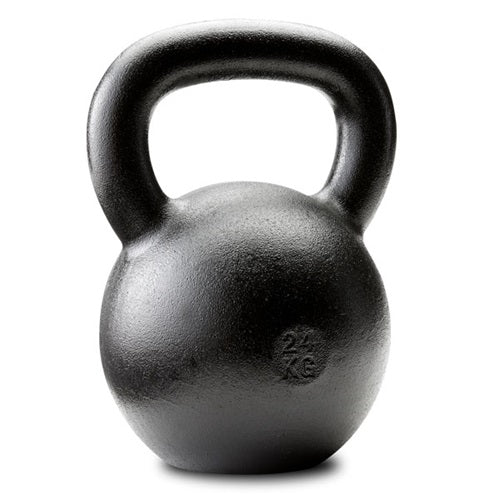
The 24 kilo RKC kettlebell became the main size for testing in the Dragon Door certifications.
Part of what I pushed for as we developed was for sensible standards for older people. If you were 60, you were not 40 any longer. You could be very strong. There’s many ways a 60 or even a 70 year old in martial arts, for instance, can have extraordinarily strong bones, and be surprisingly stronger than people who are half their age. But in many, many other ways, you don’t recover nearly as fast, you’re more prone to a possible injury. There’s things that are just not working quite as well. But you can still be a very skilled coach and still be very strong. So, let’s get real about what the weight requirements should be. Same for a woman: what are you going to really have a 110-pound woman test at?
So, as we manufactured additional sizes, we were able to come up with more realistic testing requirements, depending on the weight of the person and the gender. It’s not highly scientific. It just isn’t. I think it was like a consensus. A lot of the people who were in the RKC leadership had a lot of understanding about strength and the skill of strength.
When there was a split and Pavel started his own company, Andrea took over as the head of kettlebell certification for Dragon Door. We moved to being more friendly toward women, and to people’s age and to their weight. So it was an organic process, there was nothing there beforehand. There were no other standards to go on. So we just developed it as time went by. We were at usually 70%, 80% pass rate in an RKC. It depended. And I felt good about that — if 70% of people are passing that feels decent. If everyone’s passing that may be a little suspect.
Source
This article was originally published on dragondoor.com and is republished here with the kind permission of Dragon Door.
Original URL: https://dragondoor.com/blogs/blog/the-real-story-behind-the-birth-of-the-modern-kettlebell-movement
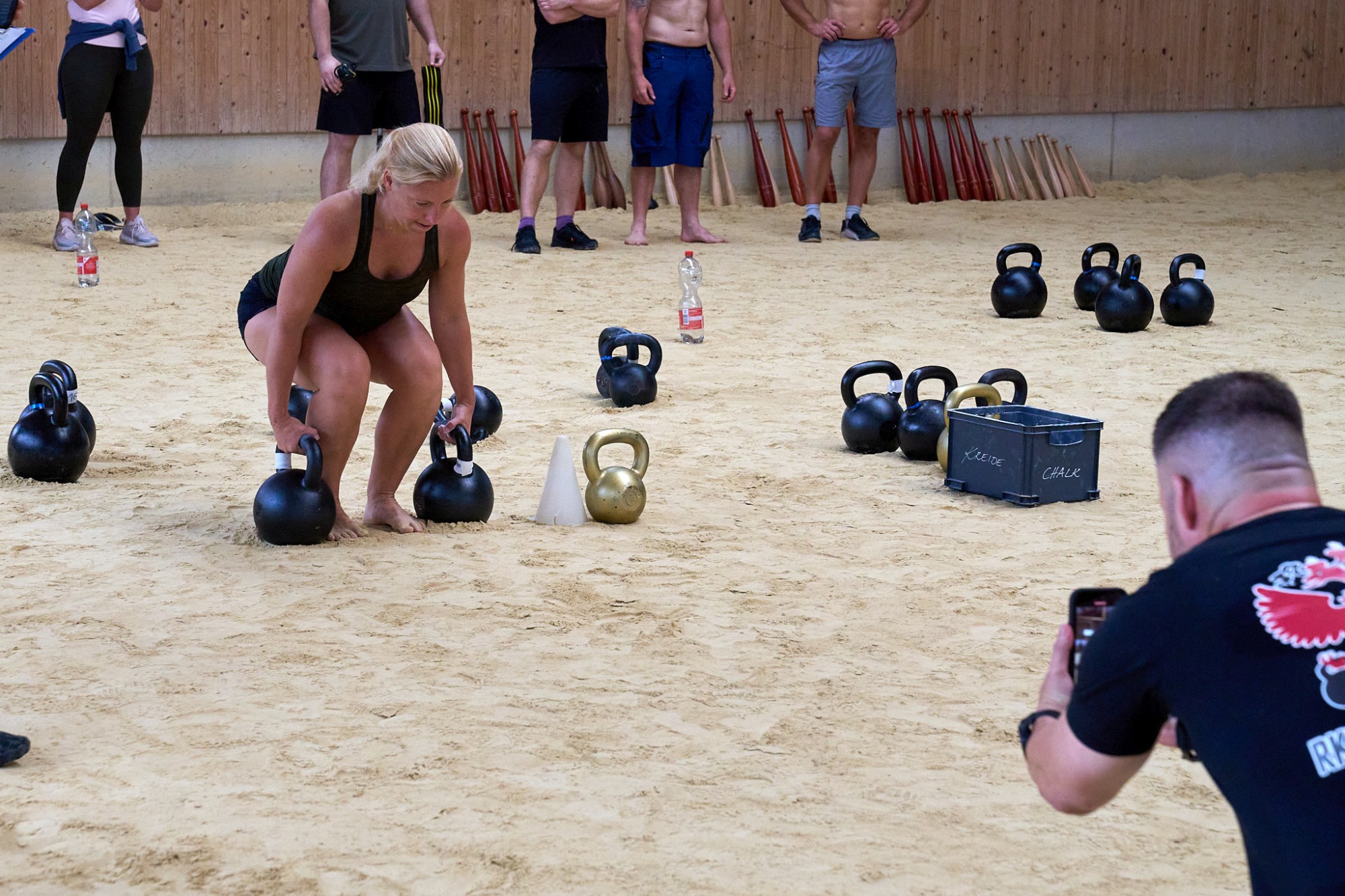
25-26.07.2026 RKC SommerCamp Pfaffenhofen an der Ilm
Trainieren, lernen, wachsen – erlebe die RKC-Community beim ultimativen Kettlebell-SommerCamp!
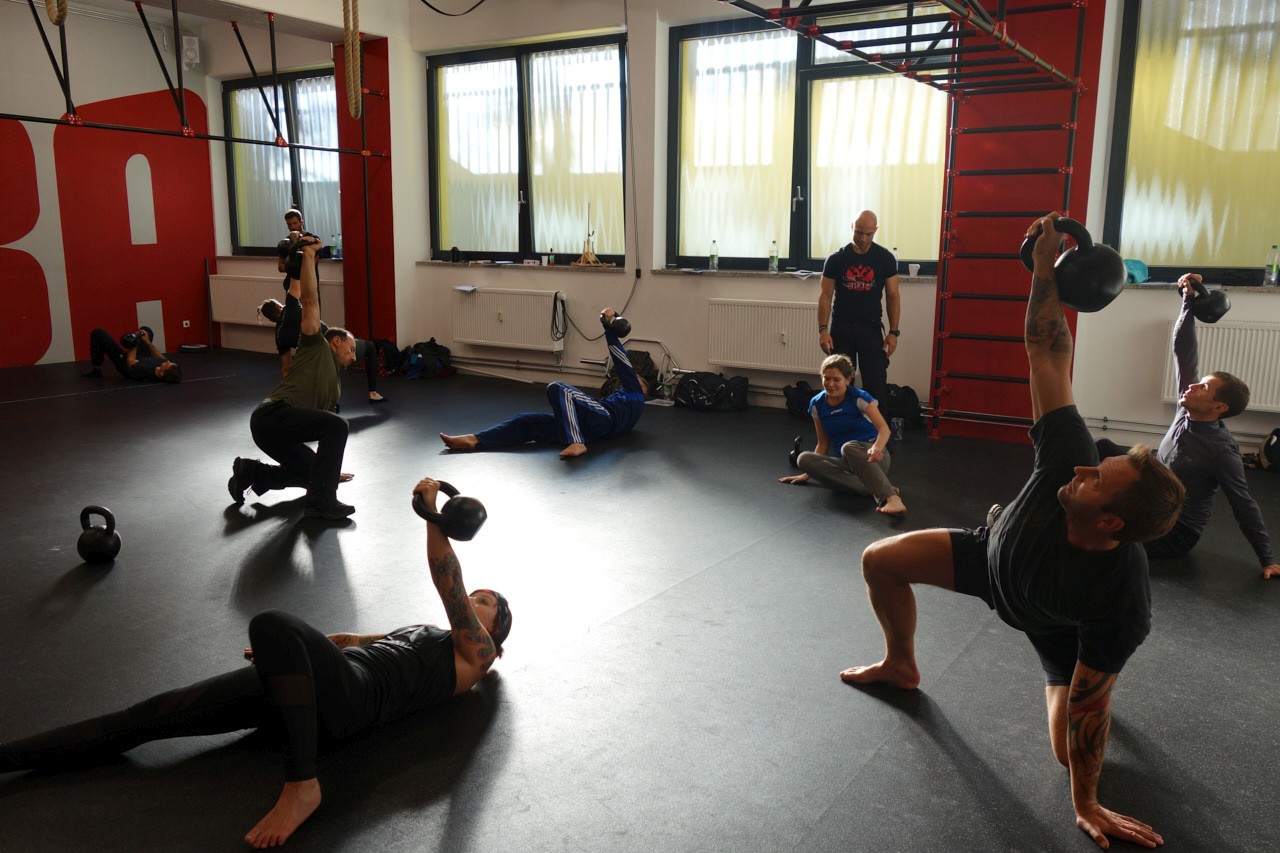
05.09.2026 RKC D-Lizenz Zertifizierung München
Gestalte deine Zukunft als Coach – mit RKC und der D-Lizenz!
06.09.2026 RKC C-Lizenz Zertifizierung München
Bereit für mehr? Mit der C-Lizenz meisterst du die nächste Stufe!
12-13.09.2026 RKC B-Lizenz Zertifizierung München
Von der Basis zur Exzellenz – mit der RKC B-Lizenz zum echten Profi!
Hol dir die originalen RKC Kettlebells!!!
Die originalen RKC Kettlebells wurden entwickelt für höchste Qualität und Langlebigkeit, perfekt für ein effektives Training nach den anspruchsvollen Standards der RKC. Setze auf das Original und spüre den Unterschied in deinem Training!