Obwohl viele gute Artikel über Kniebeugen geschrieben wurden, sehen sich Trainer häufig mit Aussagen wie „Gehe nicht unter Parallel oder 90°“, „Du solltest deine Knie nicht über deine Zehen bringen“ oder „Kniebeugen sind schlecht für deinen Rücken“ konfrontiert. Angesichts dieser Kontroversen und der Tatsache, dass die Kniebeuge eine der grundlegenden Übungen für das RKC-Kettlebell-Training ist, ist das Ziel dieses Artikels, die wichtigsten Aspekte dieser Übung zu überprüfen.
Die Kniebeuge ist vielseitig – es wurde gezeigt, dass eine 1RM-Kniebeuge stark mit der Sprung- und Sprintleistung korreliert (Wisløff et al., 2004) und sie kann die Stabilität des Knies durch die Entwicklung straffer Gelenkkapseln verbessern (Chandler et al., 1989). Sie ist besonders nützlich für das Training von Athleten, kann aber auch helfen, Kraft und Funktionalität in nicht-athletischen Bevölkerungsgruppen zu verbessern. Kniebeugen verbessern die Funktion der Gesäßmuskeln, was Verletzungen vorbeugt oder Rückenschmerzen verringert. Kniebeugen können auch jedem bei täglichen Aufgaben wie dem Heben von Gegenständen vom Boden oder dem Treppensteigen helfen. Es ist wichtig zu beachten, dass die Forschung keine Beziehung zwischen (tiefen) Kniebeugen und einem höheren Risiko für Knie- und Rückenverletzungen herstellen konnte, sofern die Übung mit der richtigen Technik durchgeführt wird (Meyers, 1971; Panariello et al., 1994; Steiner et al., 1986; Hartmann & Wirth, 2014).
Kniebeugtiefe
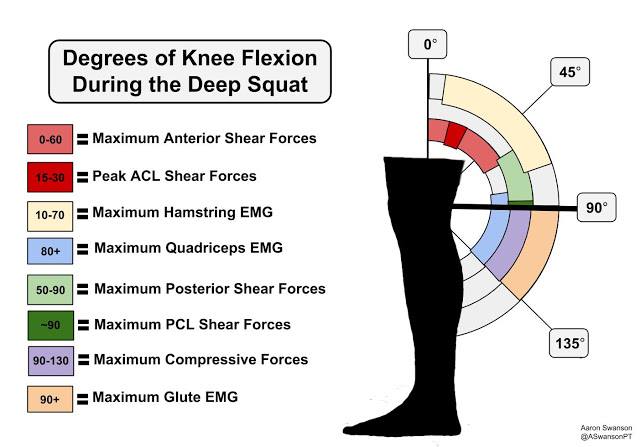
Li et al. (2004) zeigten, dass der größte Stress auf dem hinteren Kreuzband während der Kniebeuge bei etwa 90° Kniebeugung auftritt. Die Autoren stellten weiter fest, dass tiefe Kniebeugen helfen, das Kniegelenk zu stabilisieren und die anterioren und posterioren tibialen Translationen sowie die tibiale Rotation im Vergleich zu kleineren Beugungswinkeln signifikant zu reduzieren, wodurch der Stress auf die Kreuzbänder verringert wird. Li et al. (2004) fanden auch heraus, dass „die Belastungstoleranz im tiefsten Teil der Kniebeuge erhöht ist, mit einem schützenden Effekt auf die Bandstrukturen“. Dies steht im Einklang mit anderen Forschern (Kanamori et al., 2000; Li et al. 1999; Sakane et al. 1997), die einen reduzierten Stress auf die entscheidenden Bänder für die Kniebeugung bei Winkeln über 90˚ beobachteten.
Caterisano et al. (2002) untersuchten die Beziehung zwischen Kniebeugtiefe und Aktivierung des Gluteus maximus und fanden keinen Unterschied zwischen partiellen und parallelen Kniebeugen. Sie berichteten jedoch von signifikanten Zunahmen der Aktivität des Gluteus maximus während der tiefen Kniebeuge. Angesichts der hohen Inzidenz von Hüftarthrose bei ehemaligen Leistungssportlern und der Korrelation mit reduziertem passiven ROM in der Hüftbeugung (L’Hermette et al., 2004) könnten tiefe Kniebeugen ein nützliches Werkzeug zur Prävention von Hüftarthrose sein, indem sie die Hüftbeugung verbessern. Zusammenfassend gibt es Hinweise darauf, dass das Beugen unter 90° mit der richtigen Technik den Stress auf passive Strukturen wie die Kreuzbänder verringert und einen schützenden Effekt auf die Hüft- und unteren Rückengesundheit haben kann.