Breathing is an important key to performance. If you neglect it, you leave a big piece of the performance puzzle on the table.
If your mission (like mine) is to reach the apex of your physical potential—or get as close as possible—you should consciously use your breathing to reach your goals.
Why is breathing so important?
Our nervous system is divided in two parts: the autonomous nervous system and the cerebrospinal nervous system. These are complicated words for a fairly simple distinction. The autonomous nervous system (ANS) basically works on its own. Some of the tasks of the autonomous nervous system include your heartbeat, digestion, metabolism and the workings of your internal organs.
The other part of the nervous system, the cerebrospinal nervous system, is the part we are concerned with in our training. It enables us to consciously interact by:
- Perceiving our surroundings with our senses
- Reacting with the muscles in our bodies
If you ask a doctor, he probably will tell you that breathing is a function of autonomous nervous system that runs quite fine without conscious interaction on your part. While this is an objectively correct answer, it is not the whole picture. Unfortunately, many trainers leave it at this, and are ignoring the huge potential for performance enhancement.
The problem is, your autonomous nervous system does not know about your plans or your situation. The ANS reacts instinctively on perceived threats—if you encounter a dangerous situation, the ANS releases adrenaline to raise your heart rate, increase your breathing frequency, and to prime your muscles for the fight and flight response. This mechanism helped our ancestors survive to produce the next generation. However, the ANS reaction is not always the best option—especially not for athletic endeavors where energy management is often critical for success.
The RKC Snatch Test is one of those situations where breathing can easily fail you, if don’t take control. Anybody who has taken it knows that it is a staggering experience. Your energy consumption suddenly goes through the roof as a heavy iron kettlebell beats down on your body. If you are not accustomed to it, your nervous system will perceive the situation as an immediate threat, and trigger an adrenaline reaction. Initially, this will help you to use more of your strength. But if you do not take control, you will overexert yourself in the first three minutes, and probably fail in the end—or at least it will make it all much harder than necessary.
The benefits of taking control of your breathing:
- It allows you to consciously manipulate certain functions of your autonomous nervous system (i.e. keep your heart rate down).
- It ensures you do not prematurely overexert yourself.
- It gives you extra power when you need it.
- It helps you to relax.
- It quickens your recovery.
How to do it correctly…
In the RKC, we have explicit instructions for breathing in each of our main exercises. The basic idea is to inhale during the negative phase of a movement, where the least power and stabilization is needed. The short and forceful exhalation should optimally be timed with the moment of highest demand in power and/or stability during the active phase. This principle creates a very distinct rhythm for each exercise. The two major categories to differentiate exercises are ballistics and grinds, but individual exercises also benefit if the breathing pattern matches the exact demands.
The Inhale:
There is a saying in the martial arts:
“When your opponent inhales through his mouth, victory is almost yours.”
I’ve made this observation in many sparring matches. Whenever I see my opponent’s mouth opening, I throw a few fast kicks and punches his way. Usually, the match will be over in seconds. My Taekwondo grandmaster, Son Jong Ho, even stated only the first and last breath should be through the mouth.
Practice nose breathing deeply into the abdomen to create pressure below your navel. When you use this technique in a kettlebell session, you will be able to keep your heart rate much lower, which will give you more endurance and power. When you begin to practice nose breathing, you will soon feel the urge to open your mouth, but try to resist it! The longer you practice, the better it will feel.
A little experiment: Lie on your stomach with your forehead resting on your hands. Inhale deeply through your mouth. You will feel your chest expanding during each breath. Now switch to breathing through the nose. You will immediately feel your belly pressing into the floor and your chest will stop heaving. The difference is that while breathing through the nose, your diaphragm will pull your lungs down into your abdomen, increasing the pressure in your lower abdomen. If your core muscles are engaged—as they should be whenever you touch a kettlebell, this will lead to much more core stability and therefore safety. On the other hand, an inhalation through the mouth mainly engages the chest and shoulders. If those muscles are tensed during a kettlebell swing, your breathing will be severely constricted. If you need more oxygen while breathing through the mouth, you will need to inhale more often, reducing the time oxygen will be processed in your lungs. Eventually, this will lead to hyperventilation and a breakdown of your performance.
Pressurized Exhalations
Breathing is a very versatile tool. When used correctly, it can benefit you in many different situations. For our purposes, we need it to enhance stability and power during our kettlebell workouts.
We use short, pressurized exhales like hisses or shouts to increase tension and avoid losing too much air. If you fully exhale, your abdomen is completely emptied and your core muscles have nothing to hold against. Imagine a car tire. When it is filled with the correct pressure, it is hard and sturdy, but the stability goes away when it starts losing air. Stability is completely lost when it is empty.
When exhaling during kettlebell drills, do it with your lips almost closed and the tongue pressed against the roof of your mouth behind your teeth. If this makes a hissing sound, you are doing it right.
Breathing Patterns for the RKC Kettlebell Exercises
As each exercise demands a different pattern of stability and power, the optimal breathing pattern for each exercise will also be different.
Breathing for Swings
The most basic ballistic kettlebell exercise is obviously the swing. This exercise gives the kettlebell its unmatched effectiveness and safety.
The passive phase of the swing, when the kettlebell drops freely from the apex of the swing, requires almost no effort until it is caught in a deep hip hinge. Therefore, this is the time for a deep inhale to the lower abdomen, the area where we need the most internal pressure. This also provides the necessary stability during the catch. For the optimal intra-abdominal pressure, you will need to inhale through the nose. When you start practicing this, you might get the impression that you are not getting enough oxygen, so take your time and adjust the intensity of your training. With practice, you will find that you can inhale much more deeply and get much more oxygen.
When catching the kettlebell from the drop, hold your breath for maximum intra-abdominal pressure. The exhalation should be as short and forceful as you can make it and timed exactly for the moment when your hips lock out at the top of the swing. In the kettlebell swing, the time between the hip snap and the moment when the kettlebell reaches its apex is almost identical. It will be more explosive if you focus on synchronizing the exhale with your hip snap.
Breathing for Cleans and Snatches
The basic movement pattern of the clean and snatch should be identical to the swing. The inhalation and exhalation also follows the exact same principle. Be aware that with the snatch (especially) there is significant time between the hip snap and the arrival of the kettlebell in the overhead lock out. The right timing will make an even bigger difference than in the swing.
But, there is also another difference between the swing, and the clean and snatch that we need to consider for the optimal breathing pattern. This difference is the built-in pause at the top position of both exercises. While the swing is a closed-chain exercise (meaning that every rep is immediately followed by the next without a discernible pause), the clean and snatch are not. After the initial rep, which starts on the floor, each clean or snatch starts and ends at the top. How you handle breathing with this pause will depend on the context of your workout and the exercise.
If you do short sets of snatches for instance, you can simply hold the air and wait for the drop. In a situation where you are doing many snatches in a short time (i.e. Snatch Test) you might need to use this pause to exhale more, thus enabling you to refill with more fresh oxygen. You could even decide to prolong the pause for additional breathing cycles to combat oxygen debt.
If you clean for reps, then you can use the same strategies as in the snatch. If you clean for squats or presses, you should hold your breath in the top position to conserve the tension from the clean.
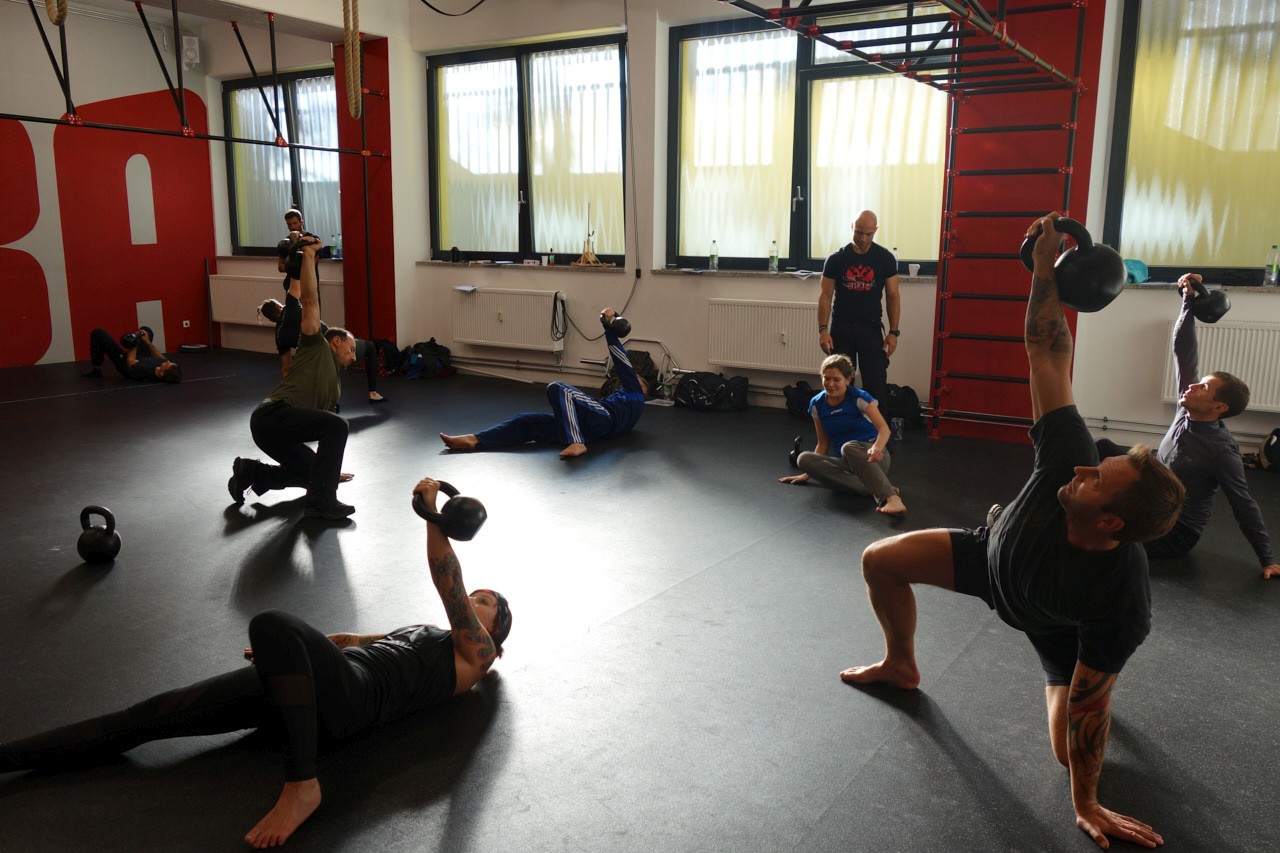
Breathing for the Get-Up
The get-up is an exercise category in itself, and it needs it very own strategy for breathing. The first challenge is that the get-up (including get down) takes at least 30 seconds (though 60 seconds is recommended). Either way, you will obviously need to breathe several times during one single rep. The second challenge is not to lose tension within the entire rep. To accommodate both demands, you need to shallow breathe while keeping your abs tight at all times (breathing behind the shield). The hardest parts of the get-up are the transitions from one position to the next. To give you the necessary strength, time small but pressurized exhalations with each transition. Refill (inhale) through the nose when you are in a static holding position.